W6YX
  • Home
  • News
  • Licensing
  • Info
  • Projects
  • Facilities
  • Old Website
  • Contact Us
  • Search
  • Calendar
  • Join our mailing list!
  • Instagram
  • Youtube

Home

Hiking Trip to Black Mountain

Details
Published: 13 November 2022

W6YX Hiking trip to Black Mountain


Saturday, Nov 19th, 2022, 9:30am to 4pm


Driving time to trail entrance: 30min
Hiking Time: 45min up, 45min down
Hiking Distance: 4 miles round trip
Hiking Altitude Change: 700 feet

We'll be hiking to the summit of Black Mountain this Saturday, Nov. 19th, 2022, to operate portable radios and antennas. We'll try making voice, digital, and CW contacts, and perhaps try making contacts using solar power as well. If conditions are good, we should be able to make contacts up to several thousand miles away.

 We plan to meet at the Tresidder parking lot at 9:30am and decide which cars to take. We'll leave Tresidder at 10am and drive to the Monte Bello Preserve parking lot on Page Mill. From there, we'll hike 2 miles to the summit.

We will eat lunch after we get to the summit, so please bring a packed lunch and one or two bottles of water with you. There is a latrine at the Black Mountain Backpack Camp, a short hike from the summit. Also, remember to dress warmly with multiple layers.

Schedule for Saturday, November 19, 2022, 9:30am to 4pm

09:30 am - Meet at Tresidder parking lot.
10:00 am - Depart Stanford Campus.
10:30 am - Arrive at trailhead. Start hike.
11:30 am - Arrive at summit. Set up equipment.
12:00 pm - Start making contacts.
12:30 pm - Lunch.
02:00 pm - Pack equipment.
02:15 pm - Start hike back down.
03:00 pm - Return to trailhead. Drive back to campus.
03:45 pm - Arrive back at campus.

Radio Equipment to bring:

  • Charged handheld radio, e.g. Baofeng UV-5R.
  • Log book or logging app.

Clothing:

  • Non-cotton layers, including a windbreaker.
  • Raincoat (just in case).
  • Hiking boots / sturdy shoes.

Food and Water:

  • Two liters of water.
  • Lunch.
  • Trail mix and/or Granola Bars.

Potato-Powered QRPp radio

Details
Published: 04 May 2022
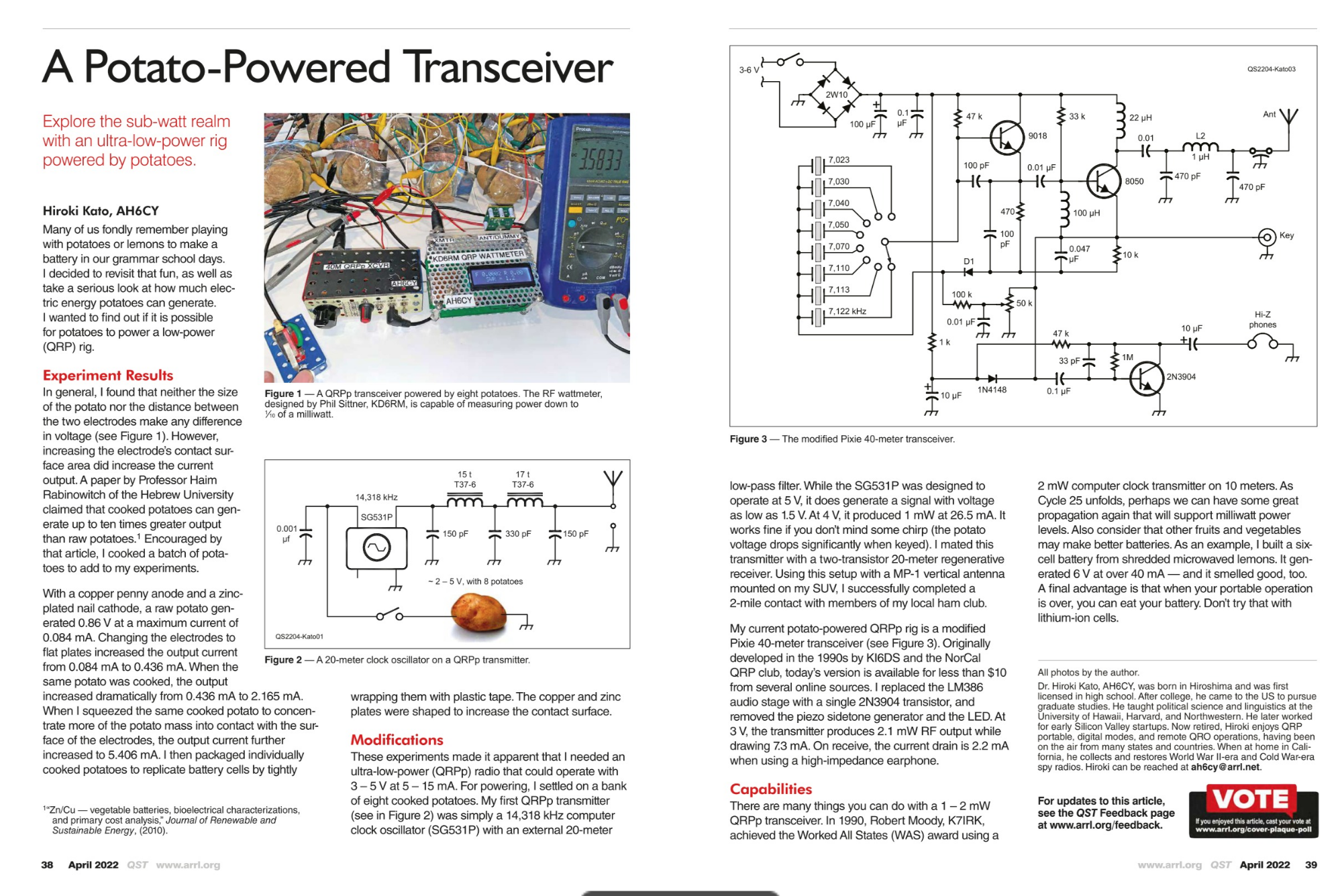
May the 4th be with you! For this month's meeting, Hiroki Kato AH6CY will give a talk about potato-powered radios.
 
 
What: Potato-Powered QRPp radio
When: Tue May 10, 7:30PM
Zoom: https://stanford.zoom.us/j/93176804730?pwd=UjRGNXZwU01rTnFUeXo0bm1QcTBXdz09
Password: 518009
 
See below for details.
 
Overview:  The talk recounts an experiment in using fruit and vegetable to power practical transceivers. It discusses how much electric energy various fruits and vegetables can generate and how to build QRPp radios.
 
About the speaker: Born in Hiroshima, Hiroki Kato was first licensed as JA4AAO when he was in high school there. He came to the US in 1966 to pursue graduate studies. Dr. Kato taught political science and linguistics at the Univ of Hawaii, Northwestern and Harvard. He came to Silicon Valley in the 1990s to work for early startups. He enjoys QRP portable ops, casual HF DX and digital modes. He collects and restores boat anchor radios, including WWII-era radios. His book The Paraset Radio: the Story of a WWII Spy-Radio and How to Build a Replica was recently published by the RSGB. His two sons attended Stanford and one of his grandsons is currently a freshman at Stanford.


Building and Operating 122 GHz Radios

Details
Published: 11 April 2022
 
For the April meeting of the Stanford Amateur Radio Club, we will have an invited talk by Mike Lavelle K6ML about 122 GHz radios. Please see below for details. Apologies for the late notice!
 
What: Building and Operating 122 GHz Radios
When: Tue April 12, 7:30 PM PDT
Zoom link: https://stanford.zoom.us/j/94535005674?pwd=cG14SXJrL0FZT1pCRGUrNkVLVmN2Zz09
Password: 561227
 
 
Overview
I will give a brief overview of the microwave spectrum and who's using it, then will describe radar sensor MMIC technology and how we repurposed it as a ham radio transceiver.   Next, the radio system budget (SNR = system gain - path loss) and how better antennas lead to greater range.  Finally, a discussion of the contributors to path loss and how path (and weather) selection led to a new distance record for this band.  Along the way, we'll learn about several radios based on the radar MMICs, including the very popular VK3CV design (about 500 units shipped to hams world wide) and the 122 GHz beacon at the W6YX site.
 
About the Speaker
Mike Lavelle (K6ML) started out on HF and 2m as WN2ZHL in high school, and then studied microwave semiconductor design in college.  As a co-op student at COMSAT Labs he built 7 and 14 GHz propagation beacons for early communications satellites.   At some point, he was mesmerized by the new 8 bit microprocessors and switched to designing computer display terminals in Silicon Valley, eventually becoming a 3-D graphics hardware architect at Sun Microsystems and later pushing some more pixels around at Silicon Image.   Now that he's retired, he's reverted to tinkering with ham radio, HF thru mm waves.


Invited Talk: Helium network & LoRaWAN

Details
Published: 08 February 2022
Who: Andy Do and Patrick van Eijk

What:


Decentralized Wireless Networking with Helium and LoRaWAN

Where:   Zoom (link)
Password: 139906
When:
Tues, Feb 8th,
7:30pm PT


Andy Do
President at Embedded Works / SensorWorks
Patrick van Eijk
Director of LoRa Business Development at Semtech

--------------------

Talk Summary:

What do you get when you utilize blockchain Decentralized Finance (DeFi) and cryptocurrency to build one of the fastest-growing wireless networks?
How would you build a global IoT wireless network in a matter of years, not decades, and at a fraction of the cost of traditional mobile carriers who might spend billions to buy spectrum, build cell towers, and gain subscribers?

The answer is the Decentralized Wireless (DeWi) movement which is growing at breakneck speeds.
At the center of this movement is the Helium blockchain, which is powered by the LoRaWAN wireless protocol that has seen tremendous growth in IoT applications.
The Helium DeWi model has amassed legions of crypto mining fans, and its “hotspot miners” have been deployed worldwide.

We’ll explore the benefits of a DeWi network and the multitude of Helium IoT applications used in small business to big city projects.

Read more: Invited Talk: Helium network & LoRaWAN

Page 2 of 6

  • 1
  • 2
  • 3
  • 4
  • 5
  • 6