![[American Radio Relay League]](old/img/arrl-c.gif)
![[W6YX QSL Card]](old/qsl_cards/w6yx.gif) Meetings are usually held on the second Tuesday of each month at 7:30 PM in Room 202 of the Packard Electrical Engineering Building, except during the summer months when meetings may be held in the club shack at Site 530.
Meetings are usually held on the second Tuesday of each month at 7:30 PM in Room 202 of the Packard Electrical Engineering Building, except during the summer months when meetings may be held in the club shack at Site 530.  Over fifty
participants and visitors were involved in this year's Field Day event. Five officers from the Department of Public Safety visited and witnessed first hand the service that the Stanford Amateur Radio Club provides to the campus community. Our ARRL and ARES section leaders
also visited our operation. Officers from the Cal Poly Amateur Radio Club, W6HBZ, also stopped by. W6YX operated in class 1F (single transmitter from an established emergency operations center site). Since a free GOTA and VHF station are not allowed in the 1F category, our GOTA station submitted its own entry as K6SU. VHF contacts were made in exhibition. The preliminary results look promising with 1983 HF QSOs, 957 of them CW, for a total of 3,430 HF points, plus 56 satellite QSOs, 11 of them CW and 5 solar powered contacts, 3 of them CW. These contacts combined with 1,150 bonus points add up to approximately 4,650 points, edging out the existing 1F record of 4504 points.
Over fifty
participants and visitors were involved in this year's Field Day event. Five officers from the Department of Public Safety visited and witnessed first hand the service that the Stanford Amateur Radio Club provides to the campus community. Our ARRL and ARES section leaders
also visited our operation. Officers from the Cal Poly Amateur Radio Club, W6HBZ, also stopped by. W6YX operated in class 1F (single transmitter from an established emergency operations center site). Since a free GOTA and VHF station are not allowed in the 1F category, our GOTA station submitted its own entry as K6SU. VHF contacts were made in exhibition. The preliminary results look promising with 1983 HF QSOs, 957 of them CW, for a total of 3,430 HF points, plus 56 satellite QSOs, 11 of them CW and 5 solar powered contacts, 3 of them CW. These contacts combined with 1,150 bonus points add up to approximately 4,650 points, edging out the existing 1F record of 4504 points.
 Over the weekend of June 26-27, 2010, the Stanford Amateur Radio Club participated in the annual ARRL Field Day operating event. The participants operated on UHF, VHF, and HF using CW, Digital Modes, and Phone. Visitor turn-out was very high, including an entire junior high school class. The club entered in Class 2F (two HF stations operating from an Emergency Operations Center) and finished with a score more than 1,000 points higher than the previous record in this category. Bonus points were earned in all categories including operating on 100% emergency power, media publicity, operation in a location accessible to the public, deployment of a public information booth, message handling including a report to the section manager, completing QSOs using satellite and natural power, presentation of educational activities, operation of a "Get on the Air" station for new hams, submitting our results via the web, and site visits by an elected official and an official of a public agency served by W6YX.
 Field Day was held at Site 530 on the weekend of June 27-28, 2009. Approximately thirty people participated on UHF, VHF, and HF using CW, Digital Modes, and Phone. The Club earned bonus points in the categories for operating on 100% emergency power, media publicity, operation in a public place, deployment of a public information booth, message handling including a report to the section manager, completing QSOs using satellite and natural power, presentation of educational activities, operation of a "Get on the Air" station for new hams, submitting our results via the web, and site visits by an elected official and an official of a served agency. The Club operated this year in category 4F (four transmitters from an established Emergency Operations Center) and its preliminary score indicates that it set a new record in this category.
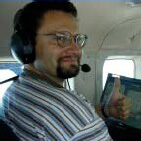 Frank N. Bauregger, Ph.D., age 38 of Mountain View, California, died Wednesday, May 21, 2008. He was a 1991 graduate of Pennsylvania State University and earned graduate degrees from Stanford University. Frank was a veteran of the United States Navy and was employed as an electrical engineer at Agilent Technologies in Santa Clara. Frank's professional career included research projects and publications about airborne anti-jam GPS antenna designs. He was a member of the Stanford Amateur Radio Club where he gave presentations on VHF/UHF communications topics. His accomplishments include being the co-holder of the world distance record for 47 GHz terrestrial communications. Frank was also a fine guitar player and enjoyed the outdoors, hunting, fishing, and hiking. Most recently, his interests expanded to include automobile drag racing.
 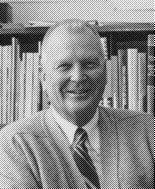 The October 2007 edition of QST, the monthly publication of the American Radio Relay League, notes that September 21, 2007 was the sixtieth anniversary of the first amateur radio single side band transmission. The contact was made by W6YX and W0TQK in 1947. The mode was championed by Stanford University researcher and author Oswald Garrison "Mike" Villard Jr, W6QYT, but it was just one of his many accomplishments. During his career at Stanford (and later at Stanford Research Institute--SRI), Villard pioneered the concept and development of a program to design and build an over-the-horizon radar system to detect incoming military aircraft and high-altitude missiles. In addition, he demonstrated the feasibility of the "stealth aircraft" concept by using specially treated low-impedance surfaces. For those achievements he received the Department of Defense civilian Medal of Honor. Another accomplishment was the design of a simple, small high-frequency receiving antenna that aided in nulling out signals that jammed broadcasts of the Voice of America, the
BBC and others. While a student at Stanford, Villlard served as president of the Amateur Radio Club, and from the 1950s through the early 1980s he was the trustee of W6YX. For a picture of him (then W1DMV) operating W6YX in the late 1930's as student president of the club, see the history section. An ARRL member for many years, Villard was also a past scientific advisor to the Northern California DX Foundation. Prof. Villard died on January 7, 2004 at age 87.
The October 2007 edition of QST, the monthly publication of the American Radio Relay League, notes that September 21, 2007 was the sixtieth anniversary of the first amateur radio single side band transmission. The contact was made by W6YX and W0TQK in 1947. The mode was championed by Stanford University researcher and author Oswald Garrison "Mike" Villard Jr, W6QYT, but it was just one of his many accomplishments. During his career at Stanford (and later at Stanford Research Institute--SRI), Villard pioneered the concept and development of a program to design and build an over-the-horizon radar system to detect incoming military aircraft and high-altitude missiles. In addition, he demonstrated the feasibility of the "stealth aircraft" concept by using specially treated low-impedance surfaces. For those achievements he received the Department of Defense civilian Medal of Honor. Another accomplishment was the design of a simple, small high-frequency receiving antenna that aided in nulling out signals that jammed broadcasts of the Voice of America, the
BBC and others. While a student at Stanford, Villlard served as president of the Amateur Radio Club, and from the 1950s through the early 1980s he was the trustee of W6YX. For a picture of him (then W1DMV) operating W6YX in the late 1930's as student president of the club, see the history section. An ARRL member for many years, Villard was also a past scientific advisor to the Northern California DX Foundation. Prof. Villard died on January 7, 2004 at age 87. 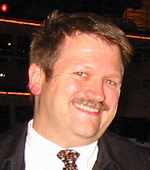 It is with deep regret that we announce the sudden passing of Paul Flaherty N9FZX, a longtime member, and past president of W6YX. Paul received his doctorate in Electrical Engineering from Stanford in 1994 for his work in computer architecture, digital radio communications, radio science and RF engineering and was considered one of the world's leading authorities on communications protocol design. After Stanford, Dr. Flaherty joined Digital Equipment Corporation's Network Systems Laboratory, where he invented and managed the Alta Vista search engine. Since then, he worked as a corporate strategist and management consultant, independently and for firms such as Zindigo and Accenture. Author of the forthcoming book, "A Better Mousetrap: Corporate Strategy for Emerging Technology", Paul has delivered international keynotes for COMDEX, Internet World, DECUS, and other trade shows in the US and throughout the world.
![[SU]](old/img/www-su.gif) Up to the Stanford University page.
Up to the Stanford University page.